
Narrative Workflow
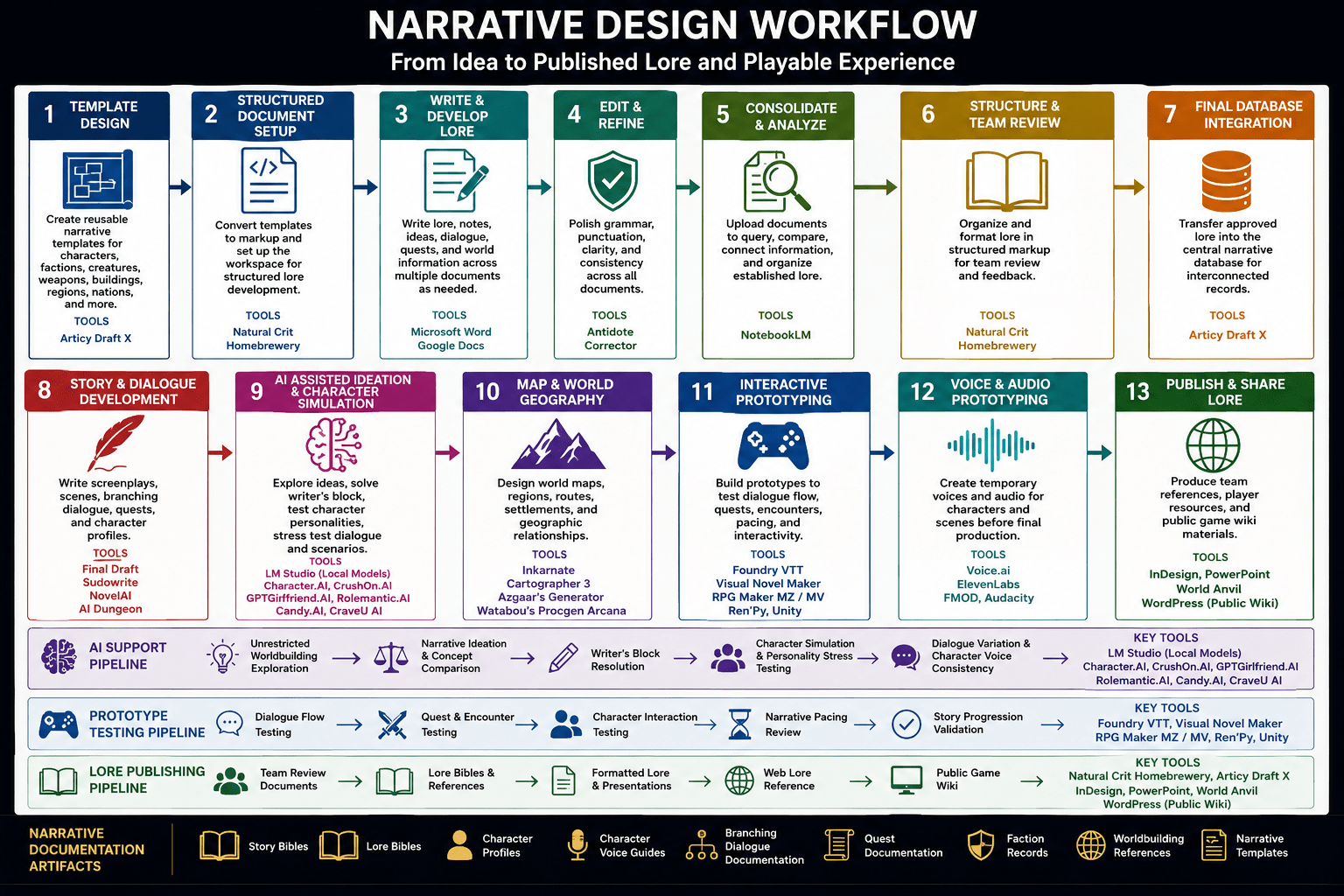
From concept and template planning through writing, review, implementation, testing, and publication.

Narrative Library
Character samples will appear here.
Selphina Haldron Character Bio
Character biography covering Selphina Haldron’s background, personality, appearance, relationships, motivations, abilities, equipment, and narrative role.
Haruka Ariadust Character Bio
Character biography covering Haruka Ariadust’s background, personality, appearance, relationships, goals, abilities, combat role, and narrative importance.
Character bark samples will appear here.
Ley Line Princess: Character Barks, Chatter & Behemoth Battle
Narrative writing sample featuring character barks, party chatter, exploration dialogue, combat coordination, contextual reactions, and a scripted Behemoth battle featuring Excellia Ciel and Momiji Fralami.
Ley Line Princess: Zurumat Boss, Barks, Chatter & Battle Sample
Narrative writing sample featuring combat barks, party chatter, exploration dialogue, tactical combat exchanges, and scripted battle scenes featuring Excellia Ciel and Momiji Fralami, including the Zurumat encounter.
Mission and quest samples will appear here.
Sunken Archive Investigation
Narrative and quest design sample covering quest structure, objectives, gameplay-to-narrative transitions, environmental storytelling, combat integration, companion conflict, branching choice, progression states, and implementation notes.
Worldbuilding samples will appear here.
Kereid Civilization
Race and civilization design document covering the Kereids’ origins, anatomy, society, religion, culture, technology, military, economy, settlements, geopolitical conflicts, and relationships with other nations.
The Fralami Clan
Faction design document covering the Fralami Clan’s history, leadership, ideology, necromantic traditions, military role, internal relationships, key members, political connections, and influence within Grez Drana.
Writing Style
My writing style is primarily geared toward systemic, linear, character-driven storytelling with meticulously layered worldbuilding, where political intrigue, class dynamics, and historical conflict are deeply embedded in both the narrative and the game systems. From a postmortem standpoint, my narrative work could best be described as blending emotionally resonant arcs with expansive, deep dive worldbuilding.
I often practice going overboard when crafting detailed nation histories, mythological frameworks, and evolving factional conflicts, all presented through tightly structured, lore rich plots that reward attentive engagement. I aim to create narratives that evolve over time, encouraging long-term investment in the arcs of characters, nations, and the world itself. As such, I tend to have a long preproduction phase.
I also would say I gravitate toward creating explorative stories where identity is fluid, whether shaped by gender, role, belief, or duty. I am drawn to characters who are reshaped by magic, politics, sex, or responsibility, often all at once. I have a tendency to try to build worlds that do not merely react to those changes but create entire systems to ritualize and sustain them.
My Narrative Philosophy
I Build Worlds Before I Write Stories
My process begins long before the first chapter, quest, or line of dialogue. I design civilizations, races, geography, history, cultures, governments, economies, religions, technologies, and political systems before narrative production begins. By establishing a coherent foundation first, stories emerge naturally from the world rather than being forced onto it.
I Believe Preparation Creates Better Narrative
I invest heavily in preproduction because I believe consistency is one of the foundations of believable storytelling. Rather than improvising major worldbuilding during production, I develop comprehensive documentation that allows characters, quests, and gameplay to remain internally consistent while reducing contradictions and plot holes.
I Design Living Civilizations, Not Static Settings
I approach worldbuilding as the design of functioning societies rather than fictional backdrops. Every race, nation, organization, and location is developed as an interconnected system where history, culture, politics, geography, biology, and technology continuously influence one another. The world should feel like it exists independently of the audience.
I Create Narrative Through Consequence
I believe meaningful stories emerge from cause and effect. Characters, gameplay systems, quests, and civilizations should respond to change through persistent consequences that reshape the world over time. The strongest narratives are those where actions continue to influence future events long after they occur.
I Treat Documentation as a Creative Discipline
Documentation is not an afterthought in my process. It is the foundation that connects narrative, gameplay, level design, art, programming, and production. Structured templates, reference material, and knowledge management allow complex worlds to remain scalable and internally consistent throughout development.
I Value Depth Over Convenience
I prefer exhaustive preproduction to reactive problem solving. I enjoy designing worlds with enough depth that they can support games, novels, encyclopedias, and future stories without requiring fundamental rewrites. My goal is not simply to tell one story, but to create a world capable of generating many.
My Positive and Supportive Stance on AI Narrative and Generation
AI Accelerates Preproduction
I use AI during preproduction to accelerate brainstorming, concept development, research, editing, mood boards, and iterative drafting. It allows me to explore significantly more ideas, compare alternatives, and refine creative direction before production begins. AI increases the speed of exploration without replacing the creative process.
Human Directed Development
Once a project enters production, concepts are transformed into production ready assets through writing, design, modeling, illustration, implementation, testing, and revision. AI may assist early exploration, but every final deliverable reflects my creative direction, judgment, and implementation.
Experience Shapes Results
The quality of AI generated output is directly influenced by the experience of the person using it. Strong results require subject knowledge, clear objectives, meaningful constraints, extensive iteration, and critical evaluation. AI is most effective when guided by someone who already understands the craft.
On Originality
I view AI as one creative tool among many. Originality is not determined by the software used, but by the decisions made throughout development. Research, worldbuilding, iteration, editing, refinement, and implementation are what transform an initial idea into a finished project. My portfolio reflects those decisions and the creative direction behind them.
On Creative Vision
I do not believe creativity is defined by whether AI was involved in a workflow. I believe creativity comes from vision, intentional design, attention to detail, revision, and the countless decisions made throughout development. AI can help explore possibilities, but it cannot replace the imagination, judgment, or craftsmanship required to complete a project.
AI is Part of My Toolset
I approach AI the same way I approach Unity, Blender, Photoshop, Substance Painter, or any other professional software. Each tool has strengths, limitations, and an appropriate place within the production pipeline. My goal is not to replace creativity with automation, but to use technology responsibly to improve efficiency while maintaining artistic and technical quality.
A good writer who knows their characters can feel like they just let the characters act on their own. They’re not writing them; they’re just cataloging their experiences. When a writer tries to force a character to do something the character doesn’t want to do, everything becomes harder.
~ Natsuko Ishikawa, Lead Writer on Final Fantasy XIV: Shadowbringers (Square Enix)